

The In Memoriam bullfight, held every June at Las Ventas once the San Isidro Festival has ended, has become one of the most traditional events of the season. This year, the tribute is dedicated to Ignacio Sánchez Mejías—far more than a bullfighter, he was a key figure in the history of Spanish literature. Here is his story.
This year’s edition of the In Memoriam bullfight is dedicated to Ignacio Sánchez Mejías, a multifaceted figure who played a particularly important role in the second decade of the 20th century. In these lines, we explore the importance and lasting legacy of a man whose significance goes far beyond that of a bullfighter.
As a bullfighter, he first gained recognition as part of Joselito El Gallo’s team, where he stood out as a banderillero before beginning his own career as a matador. Known for his brave—sometimes even reckless—style, he took his alternativa in Barcelona in 1919, with Joselito himself acting as sponsor and Juan Belmonte as witness. Joselito later became his brother-in-law after Ignacio married Dolores, one of the great torero’s sisters.
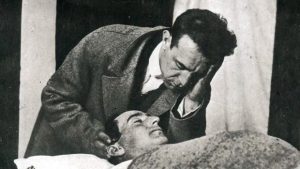
He confirmed his alternativa in Madrid the following year, just weeks before witnessing Joselito’s tragic death in Talavera. The image captured that day in the infirmary of the bullring—Ignacio overcome with grief, one hand to his face and the other gently resting on the head of the fallen master—remains one of the most iconic photographs in the history of bullfighting.
However, his influence extended far beyond the bullring. Sánchez Mejías financially supported and actively promoted the artists of the Generation of ’27, becoming a patron to an extraordinary group of writers, many of whom were devoted followers of bullfighting. Among them were Federico García Lorca, Gerardo Diego, Dámaso Alonso and Luis Cernuda. Others, such as Miguel Hernández, deeply affected by his death, dedicated poems to him, including Citación Fatal. Rafael Alberti even acted as his banderillero for a day in Pontevedra in 1927.
It was also at Ignacio’s initiative that these leading literary figures first gathered together in 1927 at the Ateneo of Seville to commemorate the 300th anniversary of the death of Góngora. In addition, Sánchez Mejías was the author of plays such as Sinrazón and Zayas, as well as numerous articles and literary works, demonstrating his remarkable cultural versatility.
He was also an actor, polo player, businessman, journalist, pilot and even president of Real Betis Balompié, leaving a deep and lasting mark on Spanish culture during the first third of the 20th century. Although he retired from active bullfighting in 1926, he decided to return to the ring in 1934. He did so in Cádiz on 15 July, followed by appearances in San Sebastián on 22 July, Santander on 5 August, La Coruña on 6 August and Huesca on the 10th—until he entered the ring in Manzanares on the 11th to replace the injured Domingo Ortega.
His death, caused by a goring suffered that day in the bullring of Manzanares by the bull Granaíno from the Ayala ranch, shocked society and deeply affected the many poets he had supported and defended. For this reason, his life and death are inseparable from Federico García Lorca’s masterpiece “Lament for the Death of Ignacio Sánchez Mejías”, an elegy that immortalised him as a symbol of culture and friendship during a golden age of Spanish history.


Bulfigthing Journalist




SERVITORO, S.L., utiliza cookies propias y de terceros para mejorar su navegación por nuestro sitio web, distinguirle de otros usuarios, analizar sus hábitos para mejorar la calidad de nuestros servicios y su experiencia de usuario, y crear un perfil de sus intereses para mostrarle anuncios personalizados. Para más información, acceda a nuestra Política de cookies. Puede aceptar la instalación de todas las cookies haciendo clic en el botón “Aceptar cookies”, configurar tus preferencias haciendo clic en el botón “Configurar cookies”, o rechazar su instalación, haciendo clic en el botón “Rechazar cookies”.